
New Testament Christology – A Summary
Objectives
- distinguish different terminology regarding Jesus
- distinguish descending and ascending approaches
- distinguish soteriology and christology
- distinguish low and high christologies
- distinguish synchronic and diachronic approaches to New Testament Christology
Which Jesus?

- The actual Jesus
- The proclaimed Jesus
- The historical Jesus
- The Living Jesus
The “actual” Jesus
- Jesus “as he really was”
- The actual human being who lived in Galilee 2000 years ago, and was killed in Jerusalem
- Who would have been recorded in the census of Tiberias
- HISTORY WILL NEVER KNOW ALL THE DETAILS, let alone his inner psychology
The “historical” Jesus
- The result of historians’ attempts to reconstruct as much as possible about “the actual Jesus”
- The result of historical research into the life and times of Jesus up to his death
- The historians’ Jesus (for some = “the Jesus of history”)
- The latest consensus of historical-critical research in reconstructing Jesus in his original context
The “proclaimed” Jesus
- The Jesus witnessed to in the New Testament and later doctrinal interpretations of his life, death and resurrection, and his meaning for their communities
- “The Christ of faith”
- A post-resurrection retrospective
- A faith interpretation
The “living” Jesus
- The Jesus known and experienced down through history, including our own times throughout the globe
- In the poor, the suffering, the marginalised
- In public liturgy and private prayer
- In our everyday life, work and family
- In relationships, friends and enemies
Three “Worlds” of Our Enquiry
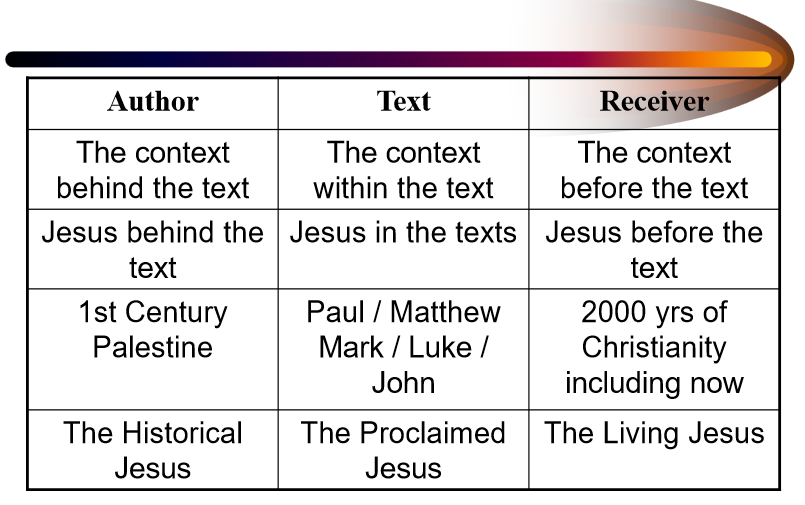
The Difference a Resurrection Makes
- The Resurrection provide “extra information” about Jesus, and became the lens through which they re-told the Jesus story
- Historical Jesus Research ends with the laying of Jesus in the tomb
- Inadequate terms: “Jesus of History” and the “Christ of Faith”
- “pre-Easter Jesus” – “post-Easter Jesus” are the better terms?
“Low” and “High” Christologies
- Low Christology: An understanding of Jesus that stresses Jesus’ humanity in a way that appears to compromise his divinity
- High Christology: An understanding of Jesus that highlights his divinity
Christology From Above or From Below
- The significance of a direction of enquiry?
- A question of method or approach that is followed in order to arrive at an understanding of Jesus
- Both methods can reveal a high christology.
- The methods are not mutually exclusive
Christology “ from above ” [Descending Christology]
- Reflection begins with the authoritative teaching about Jesus’ divine status;
- And from this authoritative statement, reflection “descends” to bring it to bear on and make sense of the historical figure of Jesus of Nazareth.
Christology “ from below ” [Ascending Christology]
- Reflection focuses on the historical figure of Jesus of Nazareth in his context;
- Reconstructs the impact he made and the initial interpretations of him as recorded in the testimony of Scripture;
- And one “ascends” to an understanding of Jesus’ saving work and divinity as asserted in doctrine.
Soteriology
- Reflection on the experience and interpretation of salvation (Greek = soteria; soter = saviour)
- What did\does Christ do for us? – Salvation – Redemption – Liberation
- The “difference” Jesus effects in our lives
- Other phrases:
- – The “work” of Christ
- – The “benefits” of Christ
Christology
- Who is this who does this for us?
- If only God can bring us such salvation, what is the relationship of this Jesus to
- – (1) the God whom he called “Abba”, and to
- – (2) the prophetic Spirit of God which he believed had descended upon him?
- If soteriology looks at “the work of Christ”, christology looks at “the person of Christ”
Avoiding Pigeon-hole Theology
- BUT contemporary christologies attempt to avoid separating too sharply:
- Soteriology and Christology
- – Abstract speculation about Jesus’ nature is useless unless it is relevant to our concrete needs for salvation
- Christology and Pneumatology
- – Jesus’ mission on behalf of his “Abba” also involves the prophetic Spirit of God
The significance of a presupposition
- Christology is “faith seeking understanding” about Christ
- We are assuming a faith position
- – “The Word was made flesh and dwelt among us” (John 1:14)
- BUT holding in tension
- – A faith position
- – A Christology from below
The importance of beginning with our Present Context
- The “faith” we presuppose is not abstract, context-less
- We are Australian Christians
- How does the Australian context of our “faith” impact upon the understanding of Christ that we seek?
Hermeneutical principle
- When we understand something, that means that we have interpreted it with a framework that enables us to apply it to our contemporary context
- The hermeneutical triad:
- – understanding,
- – interpretation,
- – application
Who is Jesus for Australia Today?
- One important way of understanding what God was on about THEN is to read the present signs of the times and see what God is on about NOW
- How is Jesus saving people NOW in Australia?
- What forces are at work impeding the reign of God NOW in Australia?
“ Receptions ” of Jesus
- The historical figure of Jesus is not to be confined to his original historical appearance (his original impact)
- Jesus is constantly being received (interpreted)
- His ongoing impact and diversity of receptions must also be “factored into” our investigations
“ impact ” and “ reception ”

Synchronic Distinctions
- syn = with; chronos = time
- a synchronic approach looks at a phenomenon from different perspectives happening at the same time
- – The Proclaimed Jesus, as we have him presented in the diverse writings of the New Testament
Diachronic Distinctions
- dia = through; chronos = time • a diachronic approach looks at a phenomenon from different perspectives down through time
- – A reconstruction of how interpretations/beliefs in Jesus developed from first encounters with him pre-Easter to diverse post-Easter interpretations
- – Reconstructing the process of selecting and rejecting some interpretations
A Genetic Structure of Understanding
- Goal: To attempt to reconstruct the genesis of Christian faith in Jesus,
- Through the lens of our faith context,
- Focusing initially on the historical figure of Jesus of Nazareth in his pre-Easter, original context,
- And early Christians’ attempts (pre-Easter and post-Easter) to name their experience of salvation in Jesus (soteriology) and who he is in relationship with God (Christology).
Complementary Approaches (1)
- 1. Diachronic, Developmental, Hermeneutical Approach
- – Reconstructing the development of NT Christologies
- – Apparent Jewish frameworks for making sense of Jesus
- Precursors (Moses, Elijah, Elisha, Jeremiah, etc)
- Models (prophet, messiah, “Son of Man”, etc)
- Titles (Son of God, Son of David, Lord, Emmanuel, etc)
- OT Narrative Matrices
Complementary Approaches (2)
- 2. Synchronic, Canonical, Comparative Approaches
- – Paul’s Christology
- – Mark’s Christology
- – Matthew’s Christology
- – Luke’s Christology
- – John’s Christology
 My Journey